Showing posts with label Homeschool Product Reviews. Show all posts

Thursday, February 16, 2012

TOS Review of See-N-Spell


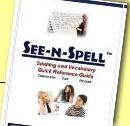
If you're looking for an easy-to-use spelling reference, check out See-N-Spell, a new spelling and vocabulary quick reference guide by the makers of See-N-Read.  See-N-Spell helps writers to easily find the correct spelling to over 300 commonly used American English words.  See-N-Spell also helps you to easily differentiate homophones by listing them together.


Let me first say what See-N-Spell is not.  It's not your typical Spelling curriculum with lists of unrelated words and tests at the end of each section.  Rather, See-N-Spell is a handy tool that can make writing so much easier, no matter what Spelling curriculum you're using, if any.  I'm one of those people who sits with a dictionary at her elbow.  My spelling isn't atrocious, but I read a lot of British detective novels and always manage to muddle the English and American spellings in my mind.  I also have a knack for stumbling over words with multiple correct spellings like canceled (or is it cancelled?) and worshiped (or worshipped).  Which begs the question of why we have a rule that says we're supposed to double the ending consonant before adding a suffix, when it isn't always followed!  The joys of learning English!  Anyway, if you don't enjoy thumbing through the dictionary as much as I do, See-N-Spell's 40 page compact reference guide will be a big help to you.  The word lists are organized alphabetically by parts of speech followed by a section on homophones for each letter.  For instance, if you're having trouble with a word beginning with H, you simply turn to the H page and can see at a glance irregular verbs such as hide/hid/hidden and the different meanings of hangar and hanger.  It would be truly embarrassing (included in the commonly misspelled words list, by the way), to write about parking your airplane in its hanger!

I have to say my favorite section is the commonly misspelled words listed alphabetically at the back of the guide.  If the word I'm having trouble with is one that others struggle to remember, too, it's faster for me to use See-N-Spell than my dictionary or Google.  If the word I'm looking for isn't listed in See-N-Spell, then I just wasted about 15 seconds, not too bad.  And while I'm pretty quick with a dictionary, my 10 and 12 year olds save a lot of time using See-N-Spell.  The best part is you can purchase See-N-Spell for only $9.99!

Photobucket

Please check out other TOS reviews of See-N-Spell.

Disclaimer:  I received a free copy of See-N-Spell in exchange for an honest review.

Friday, February 10, 2012

TOS Review of Math Rider


Are you looking for a fun and intelligent math facts game?  Math Rider helps your elementary school children learn their math facts while playing an adventure style game.  Noble quests which exemplify positive family values such as caring and honesty, help your kids learn their math facts while having fun.  The game's artificial intelligence rehearses the math facts your child needs most at a rate custom tailored for each player.  This leads to mastery of addition, subtraction, multiplication, and division facts (0-12) in record time.

Here's a screenshot from a Math Rider quest.

You can purchase Math Rider on sale for $37 (normally $47) only until February 15, 2012.  It's an instant download and please be sure to check system requirements.  I tried to download this to my PC about 20 times and had problems with Adobe Air which is required for Math Rider to run.  I kept getting an error message about a problem with installing Adobe Air on my computer that told me to contact the administrator.  I'm not terribly computer savvy, but this is the first time I've encountered this problem.  I would make sure you can get Adobe Air successfully installed on your system before purchasing Math Rider.  I was really disappointed that I couldn't get this game to work on our computer.  

Photobucket

Please check out the other TOS crew reviews of Math Rider.

Disclaimer:  I received a link to download Math Rider in exchange for an honest review, but unfortunately I was never able to get it installed on my PC.  I got my information about Math Rider from their website and a webinar they conducted for reviewers.

Monday, January 16, 2012

TOS Review of We Choose Virtues: Virtue Clue Cards


The goal of We Choose Virtues, created by mom and teacher Heather McMillan, is to inspire character in kids that lasts.  I think all parents want their children to become young men and women of character.  In fact, this is a major reason behind the homeschool movement today.  Yes, I want to be with my kids and I want them to be with one another, but mainly I want their education to be more than just academic.  In our homeschool, our goal is to glorify God above all else.  Since our house is full of people with a sin nature, that can't be accomplished without including character training.  We like to start our days with catechism, character training, and a time of prayer.


The Virtue Clue Cards are creative, cute, and easily taken with you or your child when on the go.  They're geared for kids 3-18, but I've found them helpful, as well.  My 5 and 8 yr olds enjoy assigning them to one another and then swapping them.  You can use the front side (shown above) to help your family memorize Heather's character catchphrases and antonyms.  The back of the cards give a challenge for the day and encouragement from a VirtueVille character such as Piggy Bank Frank (for patience) or Oboe Joe (obedience).

I think the Virtue Clue Cards, available at $5.99 for a limited time, would be a great addition to whatever character training program you're using in your family.  In our home we've chosen to teach character traits in conjunction with the Bible, so we wouldn't utilize the Virtue Clue Cards on their own.  I realize that We Choose Virtues is trying to be helpful to a wider audience than just Christian families so they made these virtue cards without Bible verses.  They do offer faith-based character training programs designed for Christian schools, Sunday schools, and even homeschools.  The faith-based homeschool kit, available for $99.99, includes Scriptures from the NiRV Bible on both the parenting cards and virtue flash cards.  The homeschool kit also includes a teacher's guide, several virtue posters, a personal virtue chart, and virtue user review.  I did not review this kit, but it sounds more in line with the way we do character training in our homeschool.

Even though we wouldn't use the Virtue Clue Cards on their own, we have found them to be very helpful in reinforcing the definitions of the character traits.  The virtue cards help make an abstract concept like being content more concrete.  For example, the virtue catchphrase for "content" is "have my 'wanter' under control".  The antonym for "content" given in italics is "I am NOT... bored, greedy, always wanting more, and I don't beg or whine!"  This has been helpful because our children don't necessarily realize that being bored means they're not being content, or that whining means they have a complaining attitude, which means they're not being content.  The challenges on the backs of the cards are great, too, because as we try to keep them, they show us our failures!  All of this can be discouraging apart from assuring our children that God is at work in us to will and to do for His good pleasure and that when we confess our sins to Him, He is faithful and just to forgive us.

If you're looking for a fun way to reinforce the character traits of gentleness, self-control, kindness, forgiveness, diligence, contentment, perseverance, patience, obedience, helpfulness, honesty, and attentiveness then these Virtue Clue Cards will be a great addition to your home.  They will help make the virtues come to life for your kids and this can lead to further teaching opportunities.  

Photobucket

Please check out the other TOS crew reviews of We Choose Virtues Virtue Clue Cards.

Disclaimer:  I received a free pack of the Virtue Clue Cards in exchange for a fair and honest review.  All opinions expressed above are my own.

Saturday, January 7, 2012

TOS Review of Maestro Classics: The Story of Swan Lake

I knew my kids would love this.  They love listening to books and they love dancing to music, so what could be more fun than combining the two?!  The Story of Swan Lake by Maestro Classics features The London Philharmonic Orchestra playing Tchaikovsky's famous ballet with Stephen Simon conducting.  The story is narrated by Yadu, the original narrator for the Stories in Music concerts at the Kennedy Center.


My middle four kids (3-10 years) listened intently and in turn acted out or danced along with the story.  I'm glad they enjoyed it so much, but I'm especially happy for them to be exposed to the fabulous music of Tchaikovsky.  Measle has been playing the violin for about 3 years and Prince just started lessons this week.  Listening to classical music is a very important part of the Suzuki method.


The booklet included with The Story of Swan Lake is filled with interesting facts about Tchaikovsky (also included on the CD), a mnemonic song that helps your children associate Tchaikovsky with Swan Lake (also included on the CD), a pictograph story summary to help your kids remember the plot, fun activities like dot to dot, a crossword puzzle, a maze, a tutorial on the difference between major and minor keys, and pages featuring the accoustic and electric guitar.  The CD has a total playing time of 54 minutes and has in addition to The Story of Swan Lake, which runs 33 minutes, information on Tchaikovsky's life, a guitar arrangement by Joe Stump called Speed Metal Swan, information about the music, the song "Tchaikovsky Wrote a Great Ballet", and more.


My kids had a blast with The Story of Swan Lake in the living room, but I kept thinking it would be the perfect family entertainment on our next road trip.  I plan on ordering several more Maestro Classics in the future.  I think Peter and the Wolf will be our next purchase.  I have fond memories of listening to a Peter and the Wolf record when I was a little girl.  When Lucie (3 yrs) was returning to her room to change clothes after Swan Lake, she exclaimed, "That was great!"  And I have to agree!


You can purchase Maestro Classics CDs here for $16.98 or as mp3 downloads for $9.98.  Other titles include Peter and the Wolf, The Soldier's Tale, My Name is Handel:  The Story of Water Music, The Tortoise and the Hare, Casey at the Bat, The Sorcerer's Apprentice, Juanita the Spanish Lobster, and Mike Mulligan and His Steam Shovel.   They also have a 9 CD collection available for $128, for a savings of $25!

Photobucket


Please check out the other TOS reviews of Maestro Classics!

Disclaimer:  I received a free copy of Maestro Classics The Story of Swan Lake in exchange for an honest review.

Monday, December 19, 2011

TOS Review of The World's Greatest Stories- and a Giveaway!


I first learned about George W. Sarris and The World's Greatest Stories from the blog In a Shoe.  I think this was about a year ago.  Since then we've purchased and listened to all of his Bible stories.  The World's Greatest Stories is not just another Bible story CD, though.  Several things set these CDs apart from and above other Bible story CDs.

First of all, they're not just stories, but word for word Bible.  That's right, they are completely unchanged in any way.  Pure Bible.  You can read along, if you like.  Both KJV or NIV are available.  We listen to the NIV.  As a Christian parent, I want to get as much Bible into my children's minds and hearts as possible.  This is a great way to supplement the Bible reading and memory you do as a family.

Secondly, The World's Greatest Stories is a dramatic reading of God's Word.  It's full of sound effects and mood-setting music.  And you wouldn't believe it's only one person reading the Bible.  George Sarris sounds like an entire cast of voices bringing the Bible to life in each story!  You really do have to listen to believe it.

Six volumes are available for purchase at only $7.95 each.  They are as follows:

Volume 1:  The Prophets- The Blazing Furnace, The Handwriting on the Wall, Daniel in the Lion's Den, Elijah and the Prophets of Baal, and The Prophecy of Jonah.

Volume 2:  Life of Christ- The Real Story of Christmas, The Baptism and Temptation of Jesus, The Healing of the Blind Man, Some of the Things Jesus Said and Did, and The Real Story of Easter.

Volume 3:  Beginnings- In the Beginning, A Lame Man in Lystra, A Jailer in Philippi, The Story of Ruth, and The Raising of Lazarus.

Volume 4:  Joshua and Esther- Joshua and the Battle of Jericho, and the Book of Esther.

Volume 5:  Joseph and his Brothers

Volume 6:  Defeating Giants-  David and Goliath, Naaman the Leper, Micaiah and Jehoshaphat, The Sacrifice of Isaac, and Gideon and His 300 Men.

To make a purchase or to see which Scripture passages are covered in each volume, see The World's Greatest Stories product page. 

Our family has enjoyed The World's Greatest Stories so much that I want to give away several of our favorite volumes. 

I have one copy each of volumes 1, 2, and 6 that I want to give away.  Each of the following qualifies as one entry:  Comment below, follow my blog or tell me if you already do in a comment, announce the giveaway on your blog and comment with a link, post about the giveaway on facebook or twitter and comment with a link.  Winners will be announced Thursday December 22nd.

The World's Greatest Stories is fun for the whole family.  You don't want to miss out on these Bible readings!

Photobucket

Check out other TOS Reviews of The World's Greatest Stories.

Disclaimer:  I received one volume free along with a sample CD in exchange for an honest review.  I've purchased at least a dozen other volumes for our home library and to give to friends.

Friday, December 16, 2011

TOS Review of Fractazmic Fraction Cards by I See Cards


Do you have a child who is struggling with fractions?  Have you got a visual learner who just doesn't "get" common denominators?  Fractazmic , is a card game that teaches numbers, measurement, and fractions.  The deck is divided into a sixteenths suit (brown cards), a twelths suit (blue), and a tenths suit (green). 


The sixteenths suit cards have bugs on a ruler to show that 2/16 is the same as 1/8, 2/8 is the same as 1/4, etc.  The twelths suit uses an egg carton to show 3 eggs (out of 12) is 1/4, etc.  And the tenths suit uses a water bottle to demonstrate 1/5 of a liter is 2/10, 2/5 is 4/10, etc.  The pictures on the cards help your child "see" the relationships between fractions.  The object of Fractazmic is to put together the most hands within suits that add up to 1.  You could make a green (tenths) suit of 1/10, 2/5, 3/10, and 1/5, for example.  Cards can be drawn from the stack or the discard line, but when taking from the discard line, all cards above the desired card must also be taken.  Play continues until a player runs out of cards and the winner is the player with the most hands that made one.

In my experience, teaching addition and subtraction of fractions with different denominators is tough for visual learners.  I am not a visual learner and neither is my oldest.  For us it was a simple matter to find the common denominator, but my visual girls have to be able to "see" that 1/4 is the same as 4/16 and Fractazmic does that.  Fractazmic also shows that 5/16 is is 1/4 plus 1/16 through pictures.  By playing the game, your child begins to make connections between fractions, and changing denominators is no longer a calculation to go through, but an inference from the pictures on the cards.  In other words, your child will begin to think in terms of common denominators without doing any math.  It becomes second nature. 

You can purchase a deck of Fractazmic cards through I See Cards for only $6.95.  This would be a great stocking stuffer and ideal for holiday car trips.  Other I See Cards that teach math through games are Prime Bomb and Pyramath.   Download Dr. Ron's Succeeding in Math with Games here.

Fractazmic is suited for kids in 1st-8th grade and can be played with 2-4 players.  I'm impressed with Fractazmic and may be purchasing other I See Cards in the future. 

Photobucket

Check out the other TOS reviews of Fractazmic here.

Disclaimer:  I received one Fractazmic card game free in exchange for an honest review.

Monday, December 5, 2011

TOS Review of Artistic Pursuits- Grade 4-6 Book Two


We were not new to Artistic Pursuits by Brenda Ellis when I received the opportunity to review it, which greatly added to my excitement and explains why I requested Grades 4-6 Book Two:  Color and Composition.  We had already worked through Book One on drawing last year so I knew my artistic daughter would love an intro to watercolors.

Each unit is divided into four lessons, one on observation which helps build a visual vocabulary, one on art appreciation and history, one that teaches new art techniques, and an application lesson that brings them all together.

Here's what I LOVE about Artistic Pursuits:

1.  It teaches art techniques incrementally.  You'll be amazed at what your kids can do when they work through Artistic Pursuits.  Grades 4-6 Book Two teaches color and composition.

2.  It teaches art history and art appreciation, too.  Each book focuses on a period of art or group of artists.  Grades 4-6 Book Two showcases master works by American artists.  Even if your son or daughter isn't destined to be the next Monet, they will receive a great art education by working through this series.

3.  Your kids can work through Artistic Pursuits independently.  I have absolutely no art skills, whatsoever, and am not competent to teach art.  I first purchased Artistic Pursuits because I wanted my artistic children to be able to pursue their passion, without having to depend on me.  It has not disappointed.

Artistic Pursuits is designed to be scheduled twice a week, allowing at least an hour for each session.  My daughter works fast in all her subjects.  It never takes her an entire hour and she usually does art 3-4 times a week.  Below, Twinkle Toes (10) showcases some of her recent creations.


If you have artistically inclined kids, but don't feel competent to teach art, this program is for you. 

A word of warning though, this is not a program for just fooling around with art, at least Grades 4-6 Book Two isn't.  All of the Artistic Pursuits books are reasonably priced at $42.95, but the art supplies can get pricey.  I spent $100 on the art supplies listed for Grades 4-6 Book Two ($35 alone for 12 Derwent Inktense watersoluble ink pencils).  I see that art supply packs are available through Artistic Pursuits at a reduced rate and  I could have purchased our supplies for $74 plus $11 shipping and handling.   I was happy to do it and consider it an investment in her future, because my daughter loves to create works of art.  I would not want to spend that much on a reluctant artist, however.

Photobucket

Please check out other TOS reviews of Artistic Pursuits, especially if you're interested in one of the other grade levels.

Disclaimer:  I was privileged to receive a complimentary copy of Artistic Pursuits Grades 4-6 Book Two in exchange for an honest review.

Monday, November 21, 2011

TOS Review of The Reading Game


The Reading Game is a memory card game/storybook combo for beginning readers by Kenneth Hodkinson of Wordly Wise fame.  The game, designed for kids age 4 and up, is simple to play and works!   Six sets of memory cards and storybooks are included.  The first book contains only the 30 words used in the first set of memory cards.  By the time your child progresses to the sixth book, he should have a working vocabulary of 180 sight words. 

Each set of memory cards has 60 cards with 30 pairs of words.  After playing 6 fast paced memory games, your child should be able to recognize all 30 words in the first story.  My Prince (5 yrs) really beamed with pride as he flawlessly sped through each of the books after we played the games.  My only gripe, if I have one, is the absence of capitalization and punctuation.  Hodkinson addresses this in the instructions and even suggests adding correct capitalization and punctuation as another reading activity. 

Phonetics is also easily incorporated into the game by grouping the cards of words in the same sound family.  Hodkinson lists these word families in the instructions.  For example, after playing the six fast paced memory games with the 30 words in book 2, you could line up the word cards for "glide", "side", and "hide" and emphasize the commone -ide ending and sound.  There are five such word families just in book 2.  The author suggests playing the memory games first and then emphasizing phonetics if you choose, before allowing your child to read the book.  The author also suggests having your child read one or two of his "test sentences" for each book before having them read the book.  This was unnecessary with my son, but would be helpful for kids brand-new to reading.

My son really whizzed through the books after playing the memory games and book 6 contains 180 words, including 23 of the 25 most common English words and 42 of the 50 most common English words.  The 30 words for each book are also conveniently listed at the back of each book.


You can purchase The Reading Game for $24.95 and when you consider that it includes a game plus 6 illustrated storybooks, I think it's a bargain.

Photobucket

Please check out the other TOS reviews of The Reading Game.

Disclosure:  I received The Reading Game for free in exchange for an honest review.

Monday, November 14, 2011

TOS Review of Read Naturally's One Minute Reader


We all know how important reading well is to overall education.  Read Naturally has a full line up of products aimed at increasing literacy including One Minute Reader.   I was really excited to try One Minute Reader with two of my children, Prince (5) who is a beginning reader (first grade level) and Measle (8) who struggles with reading comprehension.  I received a complete Ready, Set, Orange! set, level 1, for Prince, and a level 3 booklet for Measle.  One Minute Reader is designed to be something your child can do on their own, but mine needed some help.


Here's how One Minute Reader works:

1.  Allow your child to browse the titles, look at the pictures and select a story.  (Each booklet has 6 stories.)

2.  Set the timer for one minute and read the story out loud, underlining any unknown words.  (Your child is supposed to be doing this for himself, but I found that my 5 year old was really slowed down by handling the pencil, so I told him to just keep reading and skip any words he didn't know.  I kept track of his missed words.)

3.  Mark your cold score in blue (number of words read correctly in one minute).

4.  Read along with the CD three times.  (The CD contains each story on three separate tracks so you don't have to keep getting up and turning it back.)

5.  Read alone to raise your score.  They can do this as many as 5 times and record their score on the green lines beneath the story. 

6.  Take a short reading comprehension quiz (4 questions).

7.  Read for an adult for one minute. 

8.  Mark your hot score in red (number of words read correctly in one minute.)

One Minute Reader has lots of interesting booklets to choose from in 6 reading levels, E-5.  I think they roughly correspond with grade level, but I could be wrong.  The One Minute Reader placement exam can help determine which level of booklets your child needs.

My thoughts on One Minute Reader are varied.  I saw both of my kids' reading scores improve after completing the 8 steps.  No doubt about it, reading the story along with the CD three times helped them to recognize words they stumbled over the first time through.  I think One Minute Reader was more successful with my 5 year old than with my 8 year old, though.  Level 1 might have been a bit of a stretch for my beginning reader as his initial scores were low (teens-30s).  After reading with the CD his scores improved dramatically (doubled to tripled).  He also did well on the reading comprehension quizzes (getting 3 or 4 out of 4 each time).  And he enjoyed the process, especially the fun stickers.  Could we have accomplished the same thing by my looking over his shoulder and correcting him when he mispronounced a word?  Probably.  I think One Minute Reader is designed to save the parent work since the child is supposed to complete steps 2 through 6 on their own.  My 5 year old really wasn't able to do it on his own.  I had to be there anyway, so I just as well could have been reading with him.  That said, I will probably buy some more of the level 1 booklets because a.) it works and b.) he likes it.

My 8 year old had a completely different experience with One Minute Reader.  She also enjoyed it, which is always good when it comes to school, but her scores started out already high (in the 100s).  But my 8 year old couldn't pass the comprehension quizzes.  One Minute Reader did provide confirmation for me.  I knew this was her problem.  I had to re-read portions of our read-aloud book this morning two and three times and then explain it to her!  It makes for frustrating reading time.  I was hoping One Minute Reader might help her with comprehension, but it seems my daughter is talented at not paying attention.  She can actually read the story more than 6 times in a row and not know what she's read!  Maybe she got a little too into the timed reading thing and was reading so fast she didn't have time to process it.  She did up her scores into the 160s and higher.  She was reading really fast and she usually missed two out of four of the comprehension questions.

In my opinion, One Minute Reader is ideal for kids who are old enough to work independently, but who are also struggling with their reading.  I think kids who hesitate and stumble over words will be greatly helped by One Minute Reader. 

Students struggling with reading comprehension, however, probably need to slow down their reading until it sinks in.  We keep hoping it will sink in with Measle one of these days!  I think I'm going to have Measle go through Prince's book now and see if she can understand the easier stories.  I know she'll easily be able to read the entire stories within the minute, but hopefully she'll also begin understanding what she's reading.

If you have a struggling reader, you can purchase One Minute Reader here.  With each booklet and CD combination priced at only $12.95, you can afford to try this for yourself.  You can check out sample stories from each reading level and don't forget about the placement guide.  The starter set also which includes graphing pencil, timer, and instructional CD is $24.95.  Each complete reading level package, which includes 8 booklet/CD combos along with the timer, pencil, and instructional CD costs $99.95.

Photobucket


Please check out the other TOS reviews of One Minute Reader and other Read Naturally products.

Disclaimer:  I received a complete Ready, Set, Orange! level 1 One Minute Reader kit and a level 3 booklet in exchange for an honest review.

Friday, November 11, 2011

TOS Review: Math Mammoth


It has been my pleasure to review Math Mammoth by Maria Miller.  My oldest son is a math person, like his mama.  We didn't have to go all the way through K, 1st, 2nd, and 3rd grade math books, but rather skimmed through all four of them in two years.  He's now in 7th grade and doing well in Algebra II and rarely needs my help.  My next two girls do not learn the same way as their older brother.  I've been so frustrated trying to teach these girls math that we've all been tempted to give up and send them to public school more than once.  Part of the problem is I'm not a good teacher.  (Ironic, isn't it?  I have a PhD in a science and taught in a local University and now realize I'm a terrible teacher.)  I'm never able to really start at the beginning it seems.  It was in this desperate state that I learned I was going to receive Math Mammoth for both my 5th and 3rd grade daughters.  You can imagine how relieved I was!
We just couldn't send these sweet girls to school!
Maria offers complete math curricula for the elementary grades and supplemental materials for 1st -12th grades.   We received the complete 3rd grade curriculum (light blue series) with my daughter who is a visual learner.  She has really struggled with every math program I've tried.  She just doesn't get things that seem obvious to me.  Just counting backwards or skip counting is a challenge for her and she's 8!  My husband has been trying to work with her on her times tables and for some reason she just wasn't get it.  I remember looking at the big 1-100 number table and memorizing from that.  My husband used mnemonic devices to memorize his times tables.  We tried both of our ways and neither worked with Measle.  Maria was able to get through to our daughter where we failed.  First she introduced multiplication as groups, then as an array, and then using a number line.  Each time Measle struggled initially, but after 2 or three worksheets using each method she finally began to "see" it.  I don't think she's going to be a scientist like her mom, but she's definitely going to make it through 3rd grade math!  Hooray!


For my 5th grade daughter we just needed something to help her with fractions.  Twinkle Toes is not great at math, but she's not terrible at it either.  We noticed that each day she missed one or two problems and more often than not they were fractions.  Fortunately, Maria has supplemental math materials organized by grade (gold series) and by topic (blue and green series).   My daughter took a break from her other math curriculum and began focusing just on fractions with the Math Mammoth blue series which includes explanations.  About three weeks later she was able to test out of an entire text on fractions.  If you're just looking for some extra practice worksheets, but don't need the explanations, the green series is for you.

My overall assessment of Math Mammoth by Maria Miller is that it's thorough (the 3rd grade complete curriculum is over 300 pages), but broken down into bite-size pieces so your child doesn't have to digest too much in one day.  Not to name names, but it doesn't require a painful number of practice problems with each lesson like that math curriculum we're all familiar with that has driven our children to tears on occasion.  With Math Mammoth, math doesn't have to be the enemy.  I would especially recommend Math Mammoth blue series (topical with explanations) to anyone who has a child struggling with a particular math concept.  Sometimes you just have to take a break from the fast lane and spend more time on whatever it is that's causing your child to want to give up on math.  For us it was multiplication for Measle and fractions for Twinkle Toes.  Thanks to Math Mammoth, our girls are no longer moaning and groaning over their math each day. 

You can purchase Math Mammoth in PDF (the format I received), on CD-ROM or in book format.  The PDFs can even be filled in on the computer in case you want to go paperless.  And I haven't even told you the best part of Math Mammoth, yet. Math Mammoth is VERY reasonably priced compared to other math curricula.   You can purchase the complete curriculum (light blue series) PDF as instant download or on CD-ROM parts A and B worktexts, answer keys, tests, cummulative reviews, worksheet maker, and Software Pak for only $34.  The printed materials are slightly more and are available from Rainbow Resource Center.

And you can purchase by subject in the blue topical series for as little as $2 each.  Most of them are around $4 or $5. 

Math Mammoth has so much to offer and there's so much to see that you can even sign up for a virtual tour of their website and receive hundreds of free worksheets by subscribing.

Photobucket


Please check out the other TOS reviews of Math Mammoth.

Disclaimer:  I received the 3rd grade complete curriculum (light blue series) and fractions blue series free of charge in exchange for an honest review.

Wednesday, November 9, 2011

TOS Review of College Prep Genius: VocabCafe


VocabCafe by College Prep Genius is a series of novels aimed at increasing your teen's vocabulary, and thus their verbal SAT score.  The motto of College Prep Genius is "the no brainer way to SAT success."  I think they may be onto something.  I love the idea behind VocabCafe!  Each novel contains 300 words that are not necessarily common knowledge, but likely to appear on the SAT.  The words are italicized and in bold within the text of the novel with the definition given in a footnote at the bottom of the page.  How many times have you wondered what a word meant while reading, but were too lazy to look it up in the dictionary?  (Not that I would ever do that.)  VocabCafe provides the best of both worlds.  You're learning the words in the context of reading, the way vocabulary should be taught, or rather caught, but you're also given the dictionary definition!  And there is a word review at the end of each chapter that lists all the target words for that chapter, as well as an alphabetical word list in the appendix.  I found these latter tools to be useful in assessing whether my kids really learned the target words or not.  College Prep Genius calls this their three step program:  definition, repetition, and reinforcement.

While I absolutely love the idea behind VocabCafe and even enjoyed the books myself, I want to add a word of caution.  These books are designed with your typical teen in mind.  By this I mean what our culture thinks is expected of teens.  Reluctant readers are pulled into the story by an interesting and suspenseful plot.  The main characters in the book are all high schoolers and while the books are clean by the standards of our culture, some conservative Christian homeschooling families might be a little put off by some of what goes on in the books.  One book revolves around a murder through an internet dating scam so the kids go undercover online to catch the murderer.  (Our worst nightmare as parents in this technological age, no doubt.)  In other books parents are lied to and school is skipped, ostensibly for some "good" end.  Again, we're trying to teach our kids that the end does not justify the means.  And in one of the books a misunderstood teen vandal is sent to Planet Exile, much like a rebellious teen in our day might be sent to military school.  Boy-girl tensions are another theme I wasn't thrilled about.  There's nothing bad about the boy getting the girl in the end per se (it's G rated).  It's just that in our house "boy gets girl" means "boy marries girl".  Our kids don't live in a vacuum, however, and this is not the first time my son has encountered the theme of dating.

These are clean books in that there's no s*x or foul language.  They are fun, entertaining reads.   My 12 year old son enjoyed the books for the most part and we had some good discussions over the parts I mentioned above. 

If you're looking for a painless way for your reluctant reader to increase his vocabulary, then VocabCafe might be just the ticket.  If your teen is already a bookworm, however, he will probably not need or be overly impressed with the VocabCafe books.  Unfortunately, most of my son's generation does not read for enjoyment, and VocabCafe should draw these teens into the books and leave them with a much larger vocabulary than when they started. 

There are currently four VocabCafe novels:  I.M. for Murder, Operation High School, Planet Exile, and Summer of St Nick, covering 300 words each for a total of 1200 advanced vocabulary words!  The VocabCafe novels can be purchased for $12.95 each or as a package for $51.80 ($38.85 for a limited time).

Photobucket

Please see what the other TOS reviewers are saying about VocabCafe!

Disclaimer:  I received all four of the VocabCafe novels for free in exchange for my honest review.  The opinions expressed above are my own.

TOS Review of Keyboard Town Pals


Have you wanted to introduce typing to a younger child, but feared they weren't ready?  Keyboard Town Pals is a wonderful introductory typing program geared toward early elementary aged kids.  My 8 year old daughter LOVED learning to type with Keyboard Town Pals! 

The method is just as the name suggests.  Each letter has a name such as Amy for "a" or Frank for "f".  The characters are brought to life as finger puppets and either remain on Homekey street (the middle row) or go uptown (qwerty row) or downtown for different mnemonic activities.  For instance, when Amy goes downtown she feeds the zebra.  This shows your child that the same finger is used to type both "a" and "z" and that the ''z" key is down from "a".


Keyboard Town Pals is fun and friendly.  There are no timed typing quizzes or loud buzzers that sound when a mistake is made.  In fact, the delete and backspace keys have been disabled so that there is no pressure to fix mistakes.  Keyboard Town Pals is a positive, no stress learning experience for your child.

On the Keyboard Town Pals website, they assert that any child who is able to distinguish the letters from one another is ready to learn to type with their program.  This is probably true for young children whose parents are willing to sit at their elbow as they type.  My 8 year old daughter flew through all 8 lessons, one for each of the 8 home keys, and is well on her way to learning to type.  She has the confidence now to type stories on Microsoft Word using the proper form rather than her old hunt and peck method.  Keyboard Town Pals seemed really well suited to her learning style as it kept her engaged throughout each lesson.  (It helped that the lessons are so short.  The entire program takes one hour, broken into 8 lessons.)  However, my 5 year old son, who is reading on a first grade level, was not able to do the lessons correctly without my help.  I purposefully left him alone after helping him through the first lesson to see if he was keeping his left hand on the keyboard, but he was hunting and pecking to type the correct keys.  All that by way of saying, I think it requires some degree of finger dexterity that my 5 year old does not yet have.  If your 5 year old plays the piano or video games, he would probably do fine.  (My son is still not tying his shoes.) 

If you're looking for a fun, non-threatening program to help your early elementary aged child learn to type, then you'll be happy with Keyboard Town Pals.  If you're a crazy mom who wants to know how many words per minute your child is typing then this may not be for you.  (I'm sure I don't know anyone like that. : )  I think Keyboard Town Pals is a great first typing program and I really don't think my 8 year old daughter would have stuck with the program my older kids use.  The cute mnemonic phrases used in Keyboard Town Pals have stayed with my daughter.  She completed the program a week or so ago and in the car today she was able to tell them to me.  This program really does work.  I'm amazed that my 8 year old can type!  She's still slow and she can't spell worth a darn, but she can type.

You can purchase Keyboard Town Pals for $39.95 in either instant download or CD-ROM format.  Keyboard Town Pals is also available in Spanish and French!  And the makers of Keyboard Town Pals have recently released Little Hands Can Type, a keyboard readiness program that you can purchase in a bundle along with Keyboard Town Pals for $49.95 or for $59.95 including a concentration game, coloring book, and sticker set.  (My 5 year would probably have benefitted from completing Little Hands Can Type first.)

Photobucket

Please check out the other TOS crew reviews for Keyboard Town Pals.

Disclaimer:  I received a free CD-ROM version of Keyboard Town Pals in exchange for an honest review.  All opinions expressed above are my own.

Saturday, November 5, 2011

TOS Review of Ooka Island Adventure

Ooka Island Adventure is a downloadable game that teaches reading from the ground up.  Ooka Island is a game, but it's also more than a game.  Your child can choose to either "read" or "play" at the beginning of each login.  The reading selection has three sub-choices that move your child toward reading independence:  reading with Zobot and Auntie Kay, reading with Zobot, or reading alone.  Reading with Zobot and Auntie Kay has Auntie Kay read the story with explanations of the pictures, perfect for a child not yet familiar with books.  Reading with Zobot has Zobot reading the story while each word she reads is highlighted, similar to when you point at words on the page of a book as you read them.  Finally, your child can read on their own.  I did see under options that you can add a microphone, but I'm not sure whether any feedback will be given to your child if they mis-read or mis-pronounce a word.  This could be a potential drawback compared to reading a real book to your child. 

The game part of Ooka Island Adventure has your child moving around the island learning to read as he plays different mini-games.  The Ooka method of teaching reading was developed by Dr. Kay MacPhee, creator of the award-winning SpellRead reading intervention program.  The Ooka method used in the game "speeds [kids] through the foundational levels of reading development and beyond."  While Ooka Island claims to target kids age pre-K through 2nd grade, I would qualify that.  If you want your pre-schooler to work independently then they should be pretty computer saavy.  If you want your first or second grader to remain engaged then they should either be brand new readers or you should contact Ooka technical support and ask them to start your child's game on a higher reading level.

This is a great game for a child who is just learning his letter sounds, but not yet reading.  I had trouble keeping my 5 year old son who is reading on a late first grade level engaged, though.  My understanding is that by contacting Ooka Island technical support, they can override the beginning game sequences and have your child start the game at a higher reading level.  I did not do that.  It would be ideal if the parent could select their child's reading level prior to beginning the game.   Whenever I played with my son, we kept getting trapped in the cave of sounds.  This was like torture for both of us!  I never could get to the lighthouse (control center)!  My 5 year old son was also not really able to navigate the game by himself.  If I have to sit at his elbow, I would rather just read him a book, but maybe that's just me.  I do love books. 

One more warning.  Ooka Island has great graphics, but that comes at a price- it's a HUGE download.  I mean like 2 Gigs huge.  I do not have a nice, new computer.  Our system is at least five years old and wasn't the top of the line when we bought it.  It took a couple of hours to download onto our machine and I'm a little concerned about a crash. 

If you 've got a decent computer and a child who is just learning to read, Ooka Island Adventure would be a great buy for your family!  You can purchase Ooka Island for download here.  See pricing below:


Right now Ooka Island is available at a discount when you use the promo code below!


Please check out some other TOS crew member reviews of Ooka Island.  I think this would have been a bigger hit at our house if my 5 year old weren't such a strong reader already.

Disclaimer:  I received a 6 month subscription to Ooka Island Adventure in exchange for an honest review.

Friday, October 28, 2011

TOS Review of First Start Reading and Classical Phonics by Memoria Press


Together, the Memoria Press books First Start Reading and Classical Phonics by Cheryl Lowe make a comprehensive program for teaching reading and writing.  I've taught four of our children to read, thus far, and here's what I really like about First Start Reading.

  • It integrates reading and writing in a way I haven't seen before.  I've used a popular phonics book to teach reading in the past that leaves you on your own for the writing component.  First Start Reading includes guided printing practice for every sound and sound blend.

  • It's organized into three workbooks that provide progressively more difficult reading and printing assignments.  In lesson 5 of Book A, your child is reading "I am Sam."  By lesson 31 of Book C, your child is reading a three paragraph story about a queen!  (This also makes it easier to adapt for an older child or more experienced reader by just starting them in the next book up.)
  • I really like that the workbooks introduce writing the words one sound component at a time. This gives your child an intuitive feel for spelling. For instance, writing the word "rest" begins with one line of the sound "st", then one line of the sound "est" emphasizing "e" connected to "st", then one line of the sound "r" connected to the sound "est", and finally the complete word "rest". 

  • Dictation exercises provide listening and spelling practice while learning to read.  This is something that's been missing for us in the past.  Before, I taught my kids to read first and then worried about spelling later.  I'm learning that it's SO much easier to teach spelling alongside reading!  (And I REALLY, REALLY, REALLY wish I'd started doing dictation exercises with my 8 year old when she was 5 and just learning to read!!!)

  • Drawing pictures of objects that begin with the sound being taught provide opportunities for artistic expression, but more importantly (to me, anyway) they help solidify the connection between the written letter and its sound.

  • Your child can't fake it by looking at the pictures with First Start Reading because there are no pictures!    In fact, in First Start Reading after reading the story, your child will be asked to illustrate the passage, thus demonstrating their level of comprehension.  (As a mother of a very smart 5 year old who likes to look at pictures and guess the sentence, I LOVE this!)
  • The dictation exercises and drawing component make this a Charlotte Mason-friendly approach to teaching reading and writing.
  • Classical Phonics provides all the word lists for sounds and sound blends in one place!  What a great reference to have on hand!


When we received First Start Reading and Classical Phonics, my 5 year old son was already reading on a mid-late first grade level, but he lagged behind in his writing.  Because of this, I went ahead and had my son start in student workbook A and he blasted through it in a week.  He's now making his way through workbook B and has really improved his writing and spelling!  All that by way of saying, this program is not limited to kids who are just learning to read. 


OK, my son is a bit of a ham.  Your five year old might not enjoy First Start Reading as much as mine did, but it really is a confidence-building reading program!  In fact, First Start Reading and Classical Phonics are really more than just a reading program.  With phonics lessons and guided-writing practice, Spelling/dictation exercises, and reading comprehension assessment, First Start Reading and Classical Phonics constitute a comprehensive Kindergarten/First Grade Language Arts curriculum. 
You can purchase First Start Reading from Memoria Press for $29.95 including the teacher's guide or for $21.00 for just the student workbooks A, B, and C, but not the teacher's guide.  Personally, I don't think the teacher's guide is necessary, but it does contain about 250 pages of scripted lessons for those who are looking for that.  Classical Phonics:  A Child's Guide to Word Mastery is available for $14.95 and would be a great addition to any reading curriculum you're already using.

Photobucket

Don't forget to check out other TOS crew reviews of First Start Reading and Classical Phonics!

Disclaimer:  I received a free copy of Memoria Press's First Start Reading and Classical Phonics in exchange for an honest review.  All opinions expressed above are my own.

Wednesday, October 26, 2011

Excellence in Literature Review for TOS


I was so excited to receive Excellence in Literature:  Reading and Writing through the Classics by Janice Campbell!  My oldest son is a seventh grader this year and we received Introduction to Literature, the first year (8th grade) of the five year Excellence in Literature High School English Literature course.  I was super impressed upon looking over Janice Campbell's Introduction to Literature, but I was fearful that it would be WAY over my seventh grader's head.  In the end, it has caused me to second guess our approach to writing.  I don't think I've been requiring nearly enough of my kids, because my 12 year old son rose to the occasion and wrote a fantastic approach paper to the first short story in unit 1. 


Excellence in Literature is designed to prepare your High School, or almost High School student, for the independent study required in college.  EIL is full of links to author biographies and cultural and historical background information on each of the focus texts and your student is encouraged to use these as a starting point for their own research.  EIL emphasizes reading a work within its context and prepares your student to become competent at researching the information needed to truly understand a work.  Introductory chapters include How to Read a Book and Discerning Worldview through Literary Periods.  Honestly, one of the reasons we've been talking about sending our kids to high school is because I don't feel competent to teach literary analysis and writing.  Science and math, no problem.  Teaching writing scares me to death.  This course completely eliminates that fear.  It is so much beyond what I learned in high school and I went on to make A's in a private liberal arts university. 

I was tempted at first to skip unit 1,which uses 6 short stories as focus texts, and move on to a book I knew he'd really love like A Connecticut Yankee in King Arthur's Court (I've read it multiple times), but the writing assignments get progressively more difficult and really build upon one another.  The first unit uses short stories to teach students to recognize and compare and contrast the five literary elements in fiction:  Plot, Theme, Characterization, Setting, and Style.  Each unit takes 4 weeks to complete assuming 1-2 hours of work per day.  There is a great deal of flexibility in how you divide your time between reading, research, and writing, much like in a college level course.  There is no micromanagement of read x number of pages and write x number of paragraphs per day.  This takes getting used to for those of us tied to a strict schedule, but it's an important transition for our older students.

Around the World in Eighty Days, A Connecticut Yankee in King Arthur's Court, Jane Eyre, Pygmalion, Treasure Island, Animal Farm, The Tempest, and Gulliver's Travels serve as the focus texts for units 2 through 9.  The Honors track requires reading an additional work and more writing for each unit.  Incredibly, your 8th grader will be able to write a 650 word analytical essay by the end of this course!  That seems impossible to me, but I didn't think my son could write an approach paper just a few days ago and with the preparation Introduction to Literature gave him including the wonderful forms and models section, he cranked it out no problem.

I am so impressed with Excellence in Literature on every level.  It is academic and rigorous, yet it contains, or directs you to, all the tools your child needs to learn to write (and the rubrics you need to learn to evaluate their writing).  Excellence in Literature also emphasizes morality and good character within the classics, which your child will NOT receive in either public school or a liberal arts college!  Our son readily picked up on the character trait of loyality, which we have been studying for several weeks as a family, within "A White Heron".  It was really neat seeing him develop loyalty within a context other than our biblical and nature studies.

Each of the Excellence in Literature courses, including English I: Introduction to Literature which I reviewed, is available for puchase either in book format for $29 plus $4.95 shipping or instant e-book download for $27.   You can purchase Introduction to Literature here.  If your child is a 9th-12th grader and already an experienced writer, you may be interested in English II:  Literature and Composition, English III:  American Literature, English IV:  British Literature, or English V:  World Literature.  I recommend starting with English I:  Introduction to Literature, even for an older child, however, since it really can make a writer out of a student who has no previous writing experience.  I watched it happen and couldn't believe it!   

Photobucket

Please check out other TOS Homeschool Crew reviews of Excellence in Literature here.

Disclaimer:  I received a free copy of English I:  Introduction to Literature by Janice Campbell in exchange for an honest review.  The opinions expressed in this review are my own.

Sunday, October 23, 2011

A Christian curriculum or Christ-centered teaching... or both.

Maybe I should have titled this post, "Knowing when to say when."  It seems I'm there, when it comes to our science curriculum, anyway.  I've argued previously in a post on biblical homeschooling that I believe a Christian education is not an education gained by reading books only written by Christians, but rather is an education from a Christian worldview.  I still hold to that. 

There are many books written by secular humanists that the Lord has used in my life to draw me to Him.  In fact, I'm almost positive that I didn't read a single book or paper by a Christian during the entire course of my doctoral studies.  And yet, as I learned more and more about our bodies on a molecular level, I became more convinced that we are fearfully and wonderfully made.  These massive scientific textbooks all written with the assumption of evolution inspired me to give thanks and praise to God.  Another example is when I read America Alone several years ago and the Lord used it to completely change my life.  I went from a career woman finished having children to a stay-at-home homeschooling mom of six!  I know the credit goes to God and not to Mark Steyn, but still God did use that book in my life. 

Moreover, there are Christian authors who do not or did not believe in a literal six day creation.  Does that mean we discount everything they say?  Does that mean we shouldn't read C.S. Lewis?!  I don't think so.  But as a Christian and a scientist, I do not believe biblical creation and evolution are reconcilable.  In other words, I think by swallowing theistic evolution you must liberally interpret some parts of Scripture and ignore others. 


So... I have decided after some prayer and reflection that we are ditching our Sonlight science curriculum because at least one of the books is written with the assumption of evolution.  In fact, probably most of the books we're using this year as part of Sonlight's Core F science on the human body are written from an evolutionary point of view (I've noticed this with most of our Usborne books, history and science), but one author in particular makes her assumption of evolution clear quite often, while the others are more discreet.  My 12 yr old son has even nicknamed Blood and Guts, their evolution book.  It does not teach or endorse evolution per se, but it assumes that we are the product of evolution.  And that assumption just keeps popping up over and over again. 

It's not that I'm afraid it will brainwash my children, because they're the ones telling me that their science book is wrong.  If there were no better books available, we would stick with our current science curriculum and just continue teaching from a Christ-centered point of view.  In this case I believe a Christ-centered point of view means not only giving the credit to Christ, by whom God made all things and holds all things together, but also assuming a literal six day creation as outlined in Genesis 1. 

So, having said all that, we've made a switch.  I've never done anything like this before, changing curricula one-third of the way through the school year.  It means not finishing something.  It means I've wasted money on something we're not going to use.   That bothers me, but I know it doesn't mean failure.  Failure would have been making do with something that does not honor God and His Word when we could have been using something that teaches the same subject matter in a way that does honor God and His Word.   

I absolutely love God's Design for Life:  The Human Body by Debbie and Richard Lawrence, available through Answers in Genesis.  It was written by a husband-wife team who are both believers and engineers. 

Compare exerpts on the nervous system from Blood and Guts to God's Design and you be the judge over whether we made the right choice.

Blood and Guts:  "Bilaterally symmetric creatures no longer drifted every which way.  Their lives had direction.  Their nervous systems got bigger and much more sophisticated.  An onslaught of new information had to be dealt with by these creatures, like how to move along in a particular direction.  Gradually, a knot of nervous tissue developed at the end of the body facing the unknown.  This became the first brain.  Later, mammals developed ever bigger brains to deal with ever more complex worlds of sight, smell, and sound; not to mention internal controls like temperature and equilibrium." (Blood and Guts by Linda Allison page 112, emphasis of evolution code words mine)

God's Design:  "Have you ever seen an animal that could read a book and understand it?  Can a monkey build a building?  A parrot can repeat words, but can it carry on a conversation?  No.  Why not?  Animal's brains were not created to learn and think the same way that human brains can.  Of all of God's creatures, only man was given a mind able to think and reason at a high level. ... Be glad that God gave you a special brain and exercise it every day." (God's Design: The Human Body by Debbie and Richard Lawrence page 48 Beginner's section for younger kids.)

God's Design:  "The human brain is so complex we can never hope to fully understand it.  God has designed our brains to not only control our bodies and to react to the world around us, but to learn and think so we can understand and enjoy the world God has created."  (God's Design for Science: The Human Body by Debbie and Richard Lawrence page 49)

Do you see the difference in assumptions?  And of course, our conclusions depend largely upon our assumptions.  Why haven't we been using this curriculum all the time?  I have no idea.  I guess because the idea of Sonlight's Charlotte Mason approach to science of using living books rather than textbooks appealed to me.  I did look at God's Design for Science briefly when we were at the Creation Museum last year, but I didn't have much time and my husband was anxious to get the kids out of the bookstore, as you can imagine.  We'll be using it from now on with our younger kids.  It's geared for multi-level homeschooling grades 1-8.  I love that it's broken up into short lessons and sprinkled throughout with special features, biographies of great scientists, and fun facts that ispire awe and praise.  (Very Charlotte Mason-like and un-textbook-like on the whole.)

Disclaimer:  I figured this out on my own and had to actually buy the curriculum.  It was money well spent, though!

I've written before that our goal is to glorify God in our homeschool.  That's our top priority.  Using a science curriculum that gives God the credit for creation and leads us to praise Him for it, makes it that much easier for us to glorify God as we study science each day.

LinkWithin

Related Posts with Thumbnails
My photo
I'm an on-the-run mom to 6 kids who studied and taught exercise science in a previous life. I love all things running, nutrition, and health-related. I usually run at zero dark thirty in the morning and am often quite hungry before, during, and after my run, but I live a rich, full, blessed life with my children, family, and friends. My faith in God is my anchor, and looking to Him and His promises allows me to live fully even when life circumstances are difficult. While running gives me an appetite, my desire is to hunger and thirst for righteousness more than for physical food.