So far in my series on the Christian's perspective on meds, I've mainly focused on the individual; the individual believer's gratitude to God for the medicines He's made and the individual believer's responsibility to use only meds that are helpful, allow him to remain morally pure, and contribute to rather than take away from his sanctification. Today I want to move away from the individual to cultural considerations.
And they did not repent of their murders or their sorceries or their sexual immorality or their thefts. Revelation 9:21
You might be wondering what in the world this verse has to do with drugs or medicines. Would you be surprised to learn that the Greek word translated sorceries in the above verse is actually pharmakia? That's right, the same pharmakia from which we get our word pharmaceutics, as in drugs or medicine. Revelation 9:21 hits a little close to home in its description of a nation ripe for judgement. Are we not a nation that murders unborn babies by the million (and if socialized healthcare becomes a reality the aged may be next in line). We cling to our medicine as to our very lives, and we’re not even shameful of our rampant sexual immorality. Are we a repentant nation? Are we sorry for the murders we commit, our dishonesty, or our sexual promiscuity? Nope, as a culture we flaunt it. What about our meds? We're living in an culture where kids are placed on Schedule II drugs for the convenience of teachers and daycare workers. Have there been any long-term studies on stimulant use in children? Nope (unless you call 18 months long-term.) Actually one of the only longitudinal studies I've read showed kids who were treated long-term with stimulants were more likely to be addicted to stimulants (like cocaine or amphetamines) as adults. Well, that makes perfect sense- cram stimulants down their throats for a decade then expect their bodies to adjust when you decide they're cured and no longer need their drugs? I'm sorry, you can tell I feel strongly about this one. If one of your kids has ADHD and you're interested in this please contact me and I can give you some research articles to read.
We're living in a culture where our elderly in nursing homes are drugged-up so they won't be such a nuissance. I mean, hiring more nursing home workers would interfere with the profit margin, after all. We're living in a culture where people take anti-depressants to escape their circumstances rather than taking responsibility to try to change their circumstances (and yes, I realize sometimes that's not possible, but that's not what I'm talking about right now.) We're living in a culture that encourages, no pressures, women to use abortafacient birth control, in order to lower our carbon footprint. What's that all about? We're living in a culture that values polar bears more than it does human life!! We're living in a culture full of idolators who worship that which has been created rather than the Creator. We worship ourselves and we worship our drugs that make us feel good. I'm not going to try to decode the book of Revelation, but the clear message of this verse is that God is going to judge nations that are characterized by unrepentant murder, indiscriminate drug usage, sexual immorality, and theft. Scary, isn't it?
The light of a lamp shall not shine in you anymore, and the voice of the bridegroom and bride shall not be heard in you anymore. For your merchants were the great men of the earth, for by your sorcery all the nations were deceived. And in her was found the blood of prophets and saints, and of all who were slain on the earth. Revelation 18:23-24
Again, the Greek word translated as sorcery in the above passage is pharmakia. Verse 23 says that all the nations will be deceived by pharmakia. Could this simply be referring to a giant magic act of some sort? Perhaps. But, it could also be referring to deception or a clouding of the mind by drugs or medicine. It's easy to see how an entire culture that is hopped up on pills could be more easily deceived than one full of "sober-minded" individuals (as believers are called to be in the end-times 1 Peter 4:7).
I’m not sure why pharmakia was translated into English as sorcery. Certainly, the pharmaceutical industry was not flourishing in the 17th century as it is now. But the word pharmaceutical is derived from that same Greek word pharmakia. It is a valid translation, and I think one that makes much more sense to us now than the English Bible translators could have possibly understood. There is also another Greek word for the practice of magic, mageia. I'm not an expert in Greek, so I can't tell you the nuances of difference between pharmakia and mageia, but it does seem to me that drugs or medicines would be a better translation of pharmakia, especially considering what we know now that the original English Bible translators didn't. In fact, Strong's online Greek concordance gives medicine as the first definition of pharmakia and sorcery as the second. Interesting.
I'm not a big fan of Michael Savage, but one place I heartily agree with him is on the issue of drug testing our representatives and senators. I'd like to go one step further and know whether they're on prescription psycho-active drugs such as anti-depressants, anxiolytics, or stimulants. Are Michael Savage and I the only ones wondering whether the people in Washington are strung out on something? It certainly seems like they're out of their minds much of the time. And what about the people who voted them in? We're becoming a nation that is easily deceived. Hope and change. Well, that slogan was half right, anyway! I'm sure much of the explanation for the downfall of our system of government has to do with the lack of education and moral poverty of the voters, but could some of it also be because so many Americans are taking meds that dull their senses? To borrow a phrase from Timothy Leary, we've become a nation that has turned on, tuned in, and dropped out. And according to Revelation, this is not a good thing.
Now let's move away from looking at our nation and examine the church. Has the church taken a different path from the culture around us? Sadly, I think the answer is no. The church clings to its meds more tightly than to its Bibles. We seek the counsel of psychiatrists and psychologists before we go to the Word of God. We embrace birth control because we have chosen careers and comfortable lifestyles over having children. We let our parents and grandparents live out their twilight years in under-staffed nursing homes that keep our loved ones drugged-up enough to be manageable. Our first instinct is to run from our pain rather than ask ourselves what God may be trying to teach us through our suffering. (Paul and Christ both prayed that God would relieve their suffering, but when the answer was no, they suffered on for the glory of God. Peter says we shouldn't think it strange when fiery trials befall us.) The church in America has much the same perspective on medications as the culture around us. I don't expect the world to change its perspective, but I'm hoping that the church will wake-up and look to the Bible for guidance in this brave new world. Yes, medicine is a gift from God, but God will not tempt us to sin and if our reliance on medications leads us to sin, we must take responsibility for that, confess it, and ask the Lord to forgive us.
Let no one say when he is tempted, "I am tempted by God"; for God cannot be tempted by evil, nor does He Himself tempt anyone. But each one is tempted when he is drawn away by his own desires and enticed. Then, when desire has conceived, it gives birth to sin; and sin, when it is full-grown, brings forth death. James 1:13-15
Do we want to see the church take a stand in this area? Do we want our churches to be less worldly and more transformed by God's Word? The church is made up of believers so it starts with you and me.
If you're interested in topics related to drugs and medicine, maybe you have a question about a particular medication, then fire away. If I don't know the answer, I'll research it for you. If you want to interact on this topic head over to my blogfrog community discussion on drugs and medicines.
Showing posts with label Drugs and medicine. Show all posts
Showing posts with label Drugs and medicine. Show all posts
Sunday, August 15, 2010


Friday, August 13, 2010
The Christian's perspective on drugs and medicine part 4
If you haven't read the first three installments in this series I suggest you start with my posts on medicine as created by God, medicine as a gift of God, and medicine as it can be abused by man. Today I want to delve deeper into our identity and purpose as believers and how this knowledge will influence our perspective on taking meds.
I beseech you therefore, brethren, by the mercies of God, that you present your bodies a living sacrifice, holy, acceptable to God, which is your reasonable service. And do not be conformed to this world, but be transformed by the renewing of your mind, that you may prove what is that good and acceptable and perfect will of God.” Romans 12:1-2
I think there are three important points made in this verse that relate to the Christian’s perspective on drugs and medicines. First, our bodies should be presented to God as living sacrifices. Remember that God accepted only “unblemished” animals that were sacrificed to Him. He wanted them to be pure. The Christian must ask himself whether he can remain pure when taking a particular drug or medicine. I don't think Paul has physical purity in mind, but spiritual purity- the absence of sin. Will taking this medicine allow you to remain pure or will it cause you to sin? Birth control is a controversial area that could be discussed here. For instance, the use of intra-uterine devices do not prevent conception, but the implantation of the embryo into the uterus is prevented. For those who believe life begins at conception, this poses a problem. Can a Christian woman use an IUD and remain morally pure? I would suggest not. What about the pill (and other hormonal methods of birth control)? It's true that the pill is not normally abortafacient, but it can be. In other words, the pill normally prevents ovulation, but in some instances ovulation can occur even under the influence of the pill. The problem for the Christian who believes life begins at conception is that the pill also makes the uterus an inhospitable environment for implantation (by thinning it). So, now I ask an even more controversial question: Can a Christian woman take the pill and remain morally pure? I'll leave you to answer that.
What about medications that make you so tired that you start sleeping in instead of going to church? What about medications that make you too tired to read your Bible or too tired to care for your family? I suggest here that we have to consider the risk to benefit ratio. For instance, both anti-seizure and anti-anxiety meds are notorious for causing extreme drowsiness. It seems to me that a seizure is a serious threat that we have no other known treatment for, whereas anxiety can be combated in a number of non-pharmacological ways. These are issues the Christian has to consider. (And in case I wasn't clear enough here, I absolutely believe that people with seizure disorders need to take meds to try to control their seizures! My husband's brother died because a faith healer told him he wasn't trusting God in this area of his life- so he quit his meds. He left behind a wife and four young children.) Anxiety, however, is another matter and is largely subjective. I'm not saying someone suffering from anxiety should never take meds for their condition, just that medication should be the last resort and the benefits of the medicine must be weighed against the side-effects, in this case I'm referring specifically to negative effects on our character.
Secondly, according to Romans 12:1-2, believers are to be counter-cultural. We’re not supposed to be worldly. Is drinking the “norm” on college campuses? Then the Christian is called to take a different route. Rather than being shaped by the trends around us, we are to be shaped by the Word of God. For example, it is quite common for women to take thyroid hormone today. Is thyroid hormone evil? No, of course not, God made it and gave it to us for a purpose- and we should thank Him for it. Some people get thyroid cancer and have to have their thyroid glands removed- they have to have thyroid hormone to function. Others have over-active thyroid glands that have to be irradiated and they need thyroid hormone, too. I'm not in any way criticizing these people for taking the thyroid hormone their bodies need. But, many, many women today take thyroid hormone because it makes them feel more energetic and helps them to lose weight. Is it ok to take this route instead of eating right, getting enough sleep, or getting the exercise our bodies were designed for? Is it ok to do it just because everyone we know is doing it and our doctor suggests it or because we want our body to fit a certain image the world tells us we should look like? Not if our goal as Christians is to be counter-cultural. I believe this is a moral issue Christians must consider.
It's also very popular today and totally accepted for people to take anti-depressants. You might think there would be a stigma attached to taking a drug that changes your brain chemistry in order to make you feel differently, but there’s not. In fact, we think it’s the most natural thing in the world. I remember talking with a friend of mine years ago about her relationship with her then pre-teen daughter. My friend told me that they had been having a hard time getting along, but when she told her doctor about it he prescribed an anti-depressant for her (the mother). Once she started on her meds, she and her daughter were able to get along just fine. Did their relationship get better because of improved communication or quality time, increased sensitivity or patience? No, my friend's anti-depressant just caused the relationship issues with her daughter to no longer bother her. I wish this case were an exception, but sadly it isn’t.
Taking anti-depressants is routine in our culture. Is there a place for the prescription of anti-depressant drugs? Probably, but there are also times when we should be depressed. When we are in sin, we should feel guilt. God has designed us this way. Covering it up will not help us deal with our sin issue. Even when we are in the midst of suffering through difficult circumstances that we have no control over, we should feel sad. It's normal to be sad when our lives are falling apart. God made us this way. It's so very like the world to want to escape our sadness (especially when it's self-inflicted), but the biblical view is to throw ourselves upon the mercy of God. I'm the most drawn to God and His Word when I'm the most desperate. God uses difficult circumstance in our lives to refine us. We should run to the Lord rather than our meds for comfort. Anti-depressnat use has gotten out of hand in our culture that is so obsessed with how we feel. RC Sproul calls ours one of the most anti-intellectual generations in recorded history. What he means by this is that we value our emotions over our intellect, our feelings over rational thought. This leads me to the next application from Romans 12:1-2 in relation to meds.
Thirdly, as Christians, we are supposed to be transformed by the renewing of our minds. What exactly are we supposed to be putting into our minds to renew them? God's Word, of course! How can our minds be renewed by God’s Word when we’re busy changing our brain chemistry to suit our feelings? So, the question is, should Christians sacrifice their minds for the sake of their feelings? I think according to this passage, the answer is no.
There is one category of drugs in particular that need to be considered here: psychoactive drugs. These are drugs that change the way we think or feel. They exert their effects in the mind. I would suggest that any drug that impedes the Christian from having his mind renewed by Scripture also impedes his sanctification. God mainly uses His Word to make us more like His Son. The Bible and its application are the primary means of our sanctification. Should a believer put their feelings, their level of rest, their level of comfort, or anything above this priority of being transformed by the renewing of our minds?
In summary, the Christian must consider whether taking a particular medication will cause him to be morally impure or worldly, and whether it will interfere with his ability to have his thoughts transformed by Scripture.
I welcome your comments and would also love to interact more with you more on this topic in my blogfrog community. Stay tuned for the next installment. It will blow your mind.
Wednesday, August 11, 2010
The Christian's perspective on meds part 3

In the previous two posts in this series I discussed how medicines are made by God and should be appreciated as a gift from God. Today I want to consider a new aspect of medication, that of abuse. As often happens, what God has made and declared good, man can find a way to abuse.
All things are lawful for me, but all things are not helpful. All things are lawful for me, but I will not be brought under the power of any. Romans 6:12
Although God made drugs and medicines and declared them to be good in their original state, man in his depravity has tampered with what God has made. God made grapes that would ferment into wine. This wasn’t enough for man, so man began distilling spirits in order to make "strong drink". It’s the same way with drugs. God graciously provided medicinal purposes for the poppy plant to be used as a pain reliever or sedative, but man tampered with it and made “narcotics” to get high.
I see two considerations in the above verse. First of all, the Christian must ask himself whether taking a particular medication is helpful. We could list lots of situations in which it is obviously helpful to take medicine. We have several friends fighting cancer right now and I'm so grateful for the recent advances in oncology meds (and am praying for further advances). When we have an infection that renders us sub-par, it is helpful to take meds if they can return us to our productive state. Even when we have a mallady that has no cure, meds can sometimes be used to attenuate the severity of our symptoms, and this, too can be helpful for us. I think we must remember that what Paul has in mind here is helpful in terms of our spiritual lives. Will taking this medicine enhance my Christian walk or take away from it? Will taking this medicine allow me to serve God or His church to a greater degree (ie get me off my sickbed so I can serve others)?
Likewise, it is obviously not helpful for us to be incapacitated- either physically or mentally. Of what good are we to God when we're unconscious? If taking a particular medicine knocks us out to the point that we can't function, is this helpful? I want to consider two more verses here.
But the end of all things is at hand; therefore be serious and watchful in your prayers. 1 Peter 4:7
This word serious is sometimes translated sober-minded, the point being we have to be careful that the meds we take allow us to stay in control of our wits.
And do not be drunk with wine, in which is dissipation; but be filled with the the Spirit... Ephesians 5:18
We know it's a sin to be intoxicated, that's not the point of my including this verse. The issue in this verse is that of control. When we are controlled by a substance (drink, drug, medicine, etc.) then we are not able to be controlled by the Spirit of God which indwells believers.
This brings us to the second consideration of Romans 6:12. Paul says he will not be brought under the power of any. What does it mean to be brought under the power of something? I propose two applications here to meds: intoxication and dependence. As the verses above attest to, when we take something that intoxicates us, we are no longer in control of our faculties, we are no longer sober-minded, and we are no longer controlled by the Spirit of God. We will be more likely to sin and less likely to obey the Lord under these circumstances. I think this point is obvious, we understand as Christians why we shouldn't be intoxicated by a substance, but dependence is a little more subtle.
When we think of drug dependence we probably all conjure up images of the crack addict who severs all relationships and resorts to living on the street and stealing to get his next fix. This is an extreme example, but let's stay with it for a moment. A crack addict is controlled by his desire for crack. That controlling influence is greater than his desire to be a productive member of society, it's greater than his desire to be a law-abiding citizen, it's greater than his desire for meaningful relationships, and finally it becomes greater than his desire for life.
What does it mean to be brought under the power of a drug or medicine? It either causes us to do something we wouldn't otherwise do, or it causes us to neglect something we would otherwise do. This is my simplistic definition. Now let's move away from the extreme example of the crack addict into the more subtle realm of medicine and think about the power of dependence.
An inherently good pain reliever can be abused and made bad in a person’s life. Being brought under the power of any drug or medicine means that we are controlled by it. God calls His children to be self-controlled. To be self-controlled and to be other-controlled are mutually exclusive. We can’t be both! Either we “possess our own vessel” and are in control of our minds and bodies, or we aren’t. The Christian must consider his purpose in life to know God and glorify Him. The Christian must ask the question of whether his use of drugs or medicine is interfering with his ability to know God and glorify Him. So, back to the example of pain meds. It is widely known that narcotic pain relievers are quite addictive and many steps have been taken by medical boards and professionals to try to prevent the abuse of these meds, yet dependence continues, especially for many with chronic pain. Should the Christian with chronic pain suffer without any medication? My answer to that is: it depends. Can they take their pain meds and still function (ie work, family, church)? If taking your meds knocks you out to the point of not being able to work or contribute to your church and family, is it still ok? What if missing a dose completely wreaks havoc on you to the point that you'll do almost anything to avoid missing a dose? These are difficult considerations and I thank God that I'm not in a chronic pain situation. I'm merely posing the questions- I don't have all the answers. I have witnessed first hand, however, the devestation that dependence on pain relievers can have on a family. Is it possible to take narcotic pain relievers and not become addicted? Yes, but those with chronic pain must beware. Signs to watch for include needing to take a higher dose to have the same pain-relieving effect (tolerance), changes in behavior, and increased time spent obtaining prescriptions. Please see this more comprehensive list of the signs of addiction to narcotic pain relievers if this is something that affects your life. You can also check out this schedule of drugs according to how likely they are to produce dependence. Schedule I is the most dependency producing and Schedule V is the least likely to produce dependence. Notice that methylphenidate (Ritalin) is Schedule II, as is Oxycontin and many of the narcotic pain relievers.
What about something as harmless as caffeine? Caffeine can be beneficial in certain circumstances and it certainly doesn't cause intoxication, but can it also begin to control you? Have you been brought under the power of caffeine if skipping it one morning gives you the mother-of-all headaches which in turn causes you to be awful to your family or late to work? I'm not saying drinking coffee is a sin, I just want to challenge us to think through this issue of being brought under the power of something as it relates to drugs and medicines. If our body must have something to function then it seems to me we have been brought under the power of that substance, however seemingly harmless it may be.
In summary, believers must consider whether taking a particular medicine will ultimately be helpful for them and whether they will be able to take this medicine without being brought under its power- either in the short-run (intoxication) or over time (dependence).
I'd love to hear your reaction to this somewhat controversial post- get ready because the next one will be even more controversial :) . Feel free to comment here or join the discussion on my blogfrog community.
Monday, August 9, 2010
The Christian's perspective on meds part 2

Last time I talked about how all medicine is made either directly or indirectly by God and that as such we must acknowledge its place in our lives. Today I want to consider the benefits of meds as a gift from God.
Every good gift and every perfect gift is from above, and comes down from the Father of lights, with whom there is no variation or shadow of turning. James 1:17
I’m sure we’ve all had the experience of suffering under the effects of some illness only to find relief or healing from the use of medicine. It’s hard for us to imagine the profound influence on our lives that even the most run of the mill drug like penicillin has had. Death rates from infection plummeted between World Wars I and II largely due to the use of penicillin during the second World War. And to think it was discovered by accident, and again of natural origin (mold)! My kids and I studied the Middle Ages last year and we were struck by how the face of Europe was radically changed by the Bubonic plague. Whole generations were practically wiped out- up to 1/3 of Europe's population! Isn’t it strange to think that all that death could have been prevented by the use of modern day antibiotics?
Medicine is a gift from God, whether it brings healing or merely mitigates symptoms. God is so merciful that He never punishes us as much as we deserve. Adam and Eve’s sin brought about God’s curse on mankind and the earth. We deserve to suffer the full effects of the curse, but even in our punishment God relents and is merciful. He helps us to endure the very curse we brought on ourselves! Medicine is a gift from God and we should thank Him for it!
Stay tuned for the next post in this series and hop over to my blogfrog community if you want to interact on this topic. I'd love to have your feedback here, as well.
Saturday, August 7, 2010
New series: The Christian's perspective on meds

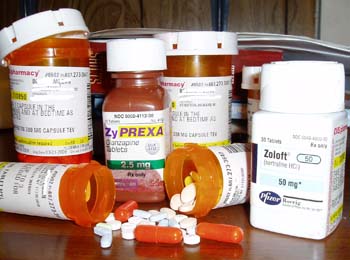
I've written a new series, five parts so far. I don't know if anyone else is interested in this topic, but it's something my mom and I and my husband and I spend a lot of time talking about. Medicines are such a large part of our lives today. Most Americans are on at least one prescription med and many take 3 or more on a regular basis. Advertising by the pharmaceutical industry has ushered in an era where patients go to their doctors already knowing the particular medication they would like to have prescribed in many cases. It's a brave new world! When I went back to school 9 years ago I viewed drugs from a mixed perspective of mystery and awe. As I studied pharmacology, pharmacokinetics, biopharmaceutics, and other disciplines in the pharmaceutical sciences I became even more amazed at the complexity of life, but something else happened as well. As I grew in my understanding of how certain meds work along with their adverse effects, my reservations of using them increased in proportion. My goal for this series is to present a balanced and biblical view of the place medicine should have and should not have in our lives.
Then God said, “Let the earth bring forth grass, the herb that yields seed, and the fruit tree that yields fruit according to its kind, whose seed is in itself, on the earth”; and it was so. And the earth brought forth grass, the herb that yields seed according to its kind, and the tree that yields fruit, whose seed is in itself according to its kind. And God saw that it was good. Genesis 1:11-12
I try to keep a running dialog with my kids about God’s marvelous creation. This gives us lots of small opportunities to praise God for what He has made. My young children always resort to asking me if God made this or that. For instance, did God make the grass? Yes, of course. Did God make the trees? Yes, of course. Did God make cars? My answer to this question is a bit more complicated and goes something like this: God made man in His image with creativity and ingenuity and He also made the natural resources that can in turn be used by man to make cars. Whew, children are little philosophers, aren’t they? Such deep questions come out of the mouths of babes! So what does this have to do with drugs and medicines? God made them, of course, either directly or indirectly. You might be surprised to learn that many medicines that we do not think of as “holistic” such as aspirin and morphine have natural origins. God made them. The active ingredient in aspirin is found in the bark of the willow tree. (Isn't it fun to think about the first time someone discovered that chewing willow bark relieved pain?) Another example is morphine, which is derived from the poppy plant. My point is simply that if God made them, they must have some purpose on our planet and in our lives. The Christian should first and foremost recognize medicines and drugs as created by God for some purpose. This allows us to praise Him for His creative genius and thank Him for His great mercy. He made these natural medicines prior to the fall, and declared them to be good, in anticipation of our need for them. Isn’t that amazing? God is so good!
Stay tuned for the next post in this series. I'm setting them to release at intervals while I'm on vacation. I'll check in to respond to comments so fire away if this topic interests you. In fact, if you want to interact on this topic, I've started a discussion on the Christian's perspective on meds in my blogfrog community.
Subscribe to:
Posts (Atom)
LinkWithin


- Celee
- I'm an on-the-run mom to 6 kids who studied and taught exercise science in a previous life. I love all things running, nutrition, and health-related. I usually run at zero dark thirty in the morning and am often quite hungry before, during, and after my run, but I live a rich, full, blessed life with my children, family, and friends. My faith in God is my anchor, and looking to Him and His promises allows me to live fully even when life circumstances are difficult. While running gives me an appetite, my desire is to hunger and thirst for righteousness more than for physical food.